The holiday season is filled with good foods. You eat and drink with your friends and loved ones to celebrate how much you care about them.
But we all know that too much of a good thing is no longer good. Too many rich foods can lead to extra pounds, digestion upsets, mood swings and a generally “yucky” feeling.
It’s all about balance.
Good, healthy holiday eating can make the difference between an enjoyable holiday season and a miserable one. The trick is to enjoy treats without overdoing them. Make a healthy holiday eating strategy and plan to enjoy the holiday celebrations without feeling bad the next day.
If you live in a rainy area, the odds are pretty good that your automobile will develop some body damage over its lifetime. Does this mean that you never wash your car because it’s going to rust out anyway? Of course it doesn’t. If you care about your car, it means that you’ll fight extra hard to protect your investment.
The reality is that most of the top killers today are lifestyle related, regardless of your family history. Just because you inherit the genes doesn’t mean that you have to continue the lifestyle.
Cardiovascular disease, cancer, diabetes, autoimmune disorders…all of these conditions are greatly impacted by diet, lifestyle habits, depressed nervous systems, our home environments, etc.
Until we change our focus from the curing of disease to the propagation of health, history is destined to repeat itself.
Remember that the body has the capacity to heal easily, as long as there is the proper balance and flow of energy. The key to staying healthy is not to inject “cures” from the outside, but rather to get the innermost layer (the meridian system) in order first, and then to insulate it with layer upon layer of healthy, productive lifestyle habits.
What does it mean to be healthy? Health is a state of optimum physical functioning, spiritual enlightenment, social well-being, and mental aptitude. True health is so much more than settling for mediocrity. It’s not about living life just barely above the doldrums, or hoping against hope that you won’t get sick or that you’ll finally feel better.
Understand that your body was designed to be healthy and in balance. This is your natural state. If you are struggling with your health, you have most likely, throughout the course of living, allowed your body to get out of balance. Taking medicine to treat a symptom will never create balance within the body. Acupuncture works with the body to return it to its natural state of balance so that it can heal from the inside out. Don’t divert the smoke, put out the fire!
Gordon Welters for The New York Times, Acupuncture may be helpful intreating migraines, arthritis, and chronic pain
I just posted a yesterday on utilizing acupuncture in the treatment of chronic pain. Today the New York Times published a wonderful article, Acupuncture Provides True Pain Relief in Study, by Anahad O’Connor.
The article is evaluating information published in the Archives of Internal Medicine, financed by the National Institues of Health, on over 18,000 patients suffering from osteoarthritis, migraines and chronic pain.
Dr. Andrew Vickers, researcher at Memorial Sloa-Kettering Cancer Center in New York states “We think there’s firm evidence supporting acupuncture for the treatment of chronic pain.”
The meta-analysis included studies that compared acupuncture with usual care, like over-the-counter pain relievers and other standard medicines. It also included studies that used sham acupuncture treatments, in which needles were inserted only superficially, for example, or in which patients in control groups were treated with needles that covertly retracted into handles.
Ultimately, Dr. Vickers and his colleagues found that at the end of treatment, about half of the patients treated with true acupuncture reported improvements, compared with about 30 percent of patients who did not undergo it.
“There were 30 or 40 people from all over the world involved in this research, and as a whole the sense was that this was a clinically important effect size,” Dr. Vickers said. That is especially the case, he added, given that acupuncture “is relatively noninvasive and relatively safe.”
I seriously have patients ask me, an acupuncturist, if acupuncture works.
My head screams “8 years of schooling, student loans, tons of continuing eduction, a life’s work…. what do you think?!”. I realize, however, what they’re really asking is “Would acupuncture work for me?“.
I also, very often, hear “I tried acupuncture and it didn’t work. I only felt better for a few days/weeks/months before the pain returned”.
Let me touch on the second point, duration of relief, and then return to efficacy.
It is insane for me to hear a patient complain about an improvement that lasts longer then 4-6 hours. The typical long-term use of muscle relaxers, narcotics, pain relievers, and anti-inflammatories cannot provide relief longer than 12 hours. If a treatment, acupuncture included, brings benefits that last longer than the VERY transient effects of the pharmaceutical industry we should mark that down as a success.
In my experience the duration of relief is completely individualized. There are a number of variables that play into the successes of the treatment.
1. Patient Compliance – are they following instructions on icing/heating, stretching, changes in posture, activity, lifestyle modifications
2. Timeline of Injury – how long has the patient been in pain?
In chronic pain it will often take some time to change the body’s perception of pain, response to injury, posture, structural alignment, etc.
In a study conducted on pain perception, Psychologic Aspects of Pain perception, researcher Mcgrath says “The perception of, expression of, and reaction to pain are influenced by genetic, developmental, familial, psychological, social and cultural variables. Psychological factors, such as the situational and emotional factors that exist when we experience pain, can profoundly alter the strength of these perceptions.”
More and more research is being conducted on acupuncture’s efficacy in pain management. We are finding that complimentary and alternative approaches to pain can be very effective. If this is true, why are patient’s still preferring a pharmaceutical solution to their pain?
Leave your answers in the comments section!
In the News: Acupuncture for Chronic Pain
A recent NCCAM-funded study, employing individual patient data meta-analyses published in the Archives of Internal Medicine, provides the most rigorous evidence to date that acupuncture may be helpful for chronic pain. In addition, results from the study provide robust evidence that the effects of acupuncture on pain are attributable to two components. The larger component includes factors such as the patient’s belief that treatment will be effective, as well as placebo and other context effects. A smaller acupuncture-specific component involves such issues as the locations of specific needling points or depth of needling.
Although millions of Americans use acupuncture each year, often for chronic pain, there has been considerable controversy surrounding its value as a therapy and whether it is anything more than an elaborate placebo. Research exploring a number of possible mechanisms for acupuncture’s pain-relieving effects is ongoing.
Reference
Vickers AJ, Cronin AM, Maschino A, et al. Acupuncture for chronic pain: a meta-analysis. Archives of Internal Medicine. 2012.
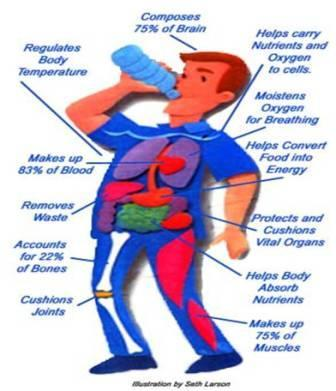
Our bodies are 60% water. It amazes me when I have to remind people to drink more water. Then again, it amazes me when I reflect on my day and realize I need to drink more water. Hyper-hydrating, or carrying around a gallon jug with you, isn’t necessary to get proper hydration. The 8 glasses of water adage isn’t a bad one, but not necessarily based in any real science. Drinking according to what your body is telling you is a much better indicator.
Signs you need to be drinking more water
1. Dark Urine or lack of urine – urine should be no darker than a pale yellow
2. Dizziness
3. Hunger
4. Sluggishness
5. Inability to sweat
6. Confusion
7. Headaches
8. Palpitations
9. Pain – especially in the low back
10. Fainting
Very often the water you are drinking with your medications helps your symptoms faster than the pill itself. Drinking a big glass of water with your Tylenol might be doing more to offset that stress headache than you realize.
Muscle consists of 75% water
Brain consists of 90% of water
Bone consists of 22% of water
Blood consists of 83% water
Benefits of Drinking Water
1. You need it to live. This goes without saying. Need more convincing?
3. Kidney troubles? Creatinine and arginine vasopressin, markers of kidney function, are dramatically improved with increased water consumption. If you tend towards kidney stones you need to keep the intake up!
4. According to The Complete Guide to Sports Nutrition you can Gain a 30% improvement in Athletic Performance
5. Bad mood? The USDA has shown that hydrating can improve memory and attitude.
Fun Fact: 20% of water come from our food. Eat your vegetables!
The Institute of Medicine determined that an adequate intake (AI) for men is roughly 3 liters (about 13 cups) of total beverages a day. The AI for women is 2.2 liters (about 9 cups) of total beverages a day.
Remember my article on chinese unicorn ants of herbal medicine? I wrote on the medicinal properties of cordyceps in chinese medicine. This herb has been used to treat a myriad of conditions including cancer, chronic fatigue, autoimmune conditions, kidney disease, blood sugar regulation, sexual dysfunction in men and women, as well as many other disease states.
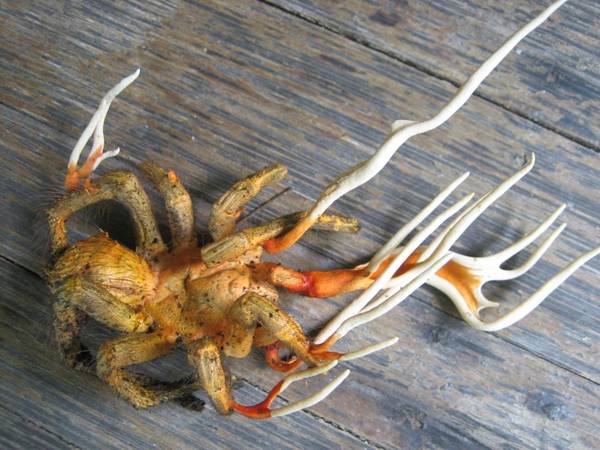
Boing, Boing! (one of my favorite blogs) did a quick piece of cordyceps found on a tarantula. YEESH!
This paper on traditional uses of cordyceps is a very interesting weekend read. Get smart!
Recently the dangers of CT scans have been all over popular news sites like NPR and The New York Times. A recent research paper has been published exposing the risks of CT scans resulting in increased risk of cancers, particularly leukemia, in children.
Example of a CTPA, demonstrating a saddle embolus (dark horizontal line) occluding the pulmonary arteries (bright white triangle)
CT scans, or computed tomography, generate 3-D images from multiple 2-D X-Rays taken around a single point. The CT scan was introduced in the 1970s as a tool throughout the medical community to diagnose diseases and abnormalities of the soft tissue that a 2-D X-ray would not be able to discern. CT scans have the ability to show abnormalities in organs, muscles, nerves, tissues (as well as bones), through the use very precise, multiple imaging. Without CT scans it would be very difficult to diagnose early stage cancers, tumors, hemorrhages, strokes, head traumas, or embolisms.
A CT scan is considered a moderate to high radiation risk due to the multitude of X-Rays being taken of one location. This radiation exposure could be 10 to 100 times that of a normal X-Ray. Radiation risk is assessed based on location of the imaging, amount of radiation a person has been exposed to (previous CT, X-Rays, environmental exposures), patient age, patient build (a small child vs an NFL football player), and precision of desired image quality (discerning the border of a palpable tumor vs trying to locate a small cerebral aneurysm).
The research paper suggesting that CT scans create an increased risk of brain cancers and leukemias in children could create a fear based back-lash against this amazing diagnostic tool that could prevent the diagnosis of disease or injury. There are two critical points to remember in regards to this paper.
1. Leukemias are primarily a cancer of children. Suggesting that CT scans foster an increased risk of a cancer that already has a higher incidents in children that do not have CT scans is flawed researching. There is no way, based on the methodology of this paper, to prove that the children exposed to the CT scans would not have leukemia regardless. There are a number of variables to consider. The subject population in the research article were already a sick sample study. These children were included in the study because they had no prior cancer diagnosis but still received a CT scan before the age of 22. This does not account for any other variables that could increase the likelihood of cancer in this population. If anything, it should be more closely inspected because the sample population already had conditions warranting medical intervention.
2. CT scans are a diagnostic tool and not a toy. CT scans have been used in diagnostic medicine more and more frequently in incidents where simple X-Rays, bloodwork, or proper medical intakes would suffice. The Center for Radiologic Research published a paper critiquing the use of CT scans in asymptomatic patients and its relationship to cancers in all patient populations. This research paper suggests that 1/3 of ALL CT scans are unnecessary.
Perhaps it is due to the litigious nature of our society that physicians are using CT scans to diagnose conditions do not warrant the risk of exposure to radiation. Dr. Brenner, director of the Center for Radiological Research at the Columbia University College of Physicians and Surgeons, stated that “young people were often given CT scans to diagnose kidney stones, appendicitis and dental problems, and that some of those scans could have been avoided by using other methods, like ultrasound or conventional X-rays.”
Ultimately, throwing such a revolutionary and invaluable diagnostic tool “under the bus” by using buzz words and headlines creating a fear based environment that CT scans are increasing cancers in children is bad reporting, bad science, and bad press. Unnecessary CT scans are exactly that, unnecessary, and not without their risks. However, it is the invention and implementation of CT scans that will save the lives of young children who would die without the advantages of modern medicine in the diagnosis of many conditions.
When treating my patients I put great emphasis in a thorough medical evaluation with an exhaustive medical history. A good medical history by a trained medical practitioner will steer most patients in the direction of health and well-being. A great medical history will determine whether or not further diagnostic tools are required. It is important in the medical community that physicians do not become complacent in connecting with and listening to their patients. CT scans are not a replacement for good traditional medicine, they are a supplement when more investigation and other diagnostic tools have been exhaustive.
It’s the middle of marathon season and a number of my patients have been limping through the door with pain at the outside of their knee or hip. The most common cause of lateral knee pain in runners is Iliotibial Band Friction Syndrome.
Location and Function
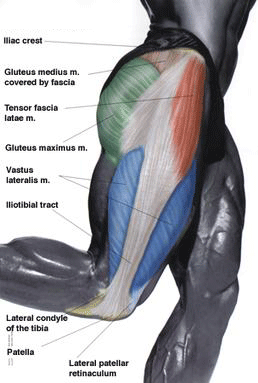
The IT band, and the pain associated with it’s inflammation, is the kink in a runner’s stride. The IT band begins at the external iliac crest (Hip Bone) and ends at the lateral condyle of the tibia (outside of the knee on the lower leg). The IT band stabilizes the knee during the stride and is usually aggravated in individuals who are overtraining, overpronating (rolling on the outside your foot when you walk) in their stride, or have oppositional workout to work habits.
This last little bit is seen in someone who is working at a desk the majority of the day then goes for a long run in the evening. The muscles that are long and stretched when running are short and tight when you are sitting for long periods of time. This is also seen clinically in triathletes that are training for long rides on their bikes and then run. In situations like this stretching throughout the day while at your desk is integral in recovery of IT band pain. In cyclists, making sure your bike is properly fitted so your leg extension is appropriate and your toes do not point inward.
WHAT IS GOING ON?! MAKE IT STOP HURTING!
With IT Band Syndrome, ITBS, the IT band is rubbing at the hip or rubbing at the knee and creating an inflammation of the tendon and surrounding tissues. IT band pain may be most noticeably after running, or engaging in the offending activity, for a period of time with the trigger spots being at the outside of the knee, hip or the line connecting the two.
Problems:
•Running around a track, the shoulder of the road, or a banked surface
•Tight muscles, as mentioned for the desk worker
•Increasing Distance, Duration, or Intensity of workout too quickly
•Over-pronanting at the food strike in running
•Toes facing frame in cycling
How do I know if I have a problem?
•Do you have pain when you press along the outside of your thigh with moderate pressure while your leg is extended?
•Do you have a noticeable wear pattern on the outside heel of your running shoe?
•Do you feel like you have a weak core or weak back?
•Is the pain worse midway through your run?
•Do you notice a “snapping hip” where it feels like the muscle or tendon is crossing the outside of your hip can be felt while you run?
•Do you have a slow pace or a short stride?
Treatment
Ok, ok, I have a busted IT band. HELP!
Getting evaluated by a licensed and experienced practitioner can make all the difference in the world with ITBS but there are a few things you can try doing at home first.
STRETCH (we will come back to proper stretching techniques)
ICE/HEAT (ice for 20 minutes post workout; use heat prior to workout and after icing)
ANTI-INFLAMMATORIES
Getting on a good Omega-3 Fish Oil protocol of approximately 3-4g a day will help mitigate inflammation
NSAID, like Ibuprofen, can help but may have side-effects to consider
SLEEP: this is when your body heals itself. You have to be getting adequate sleep
SUPPLEMENTAL THERAPY
Find an acupuncturist, chiropractor, massage therapist, or physical therapist trained and experienced with athletes
SOAK in a hot bath with Epsom Salts
Evaluation
Some of the things a practitioner will look for in ITBS are muscle imbalances.
•Hip abductor weakness can cause pain because the thigh bone, femur, has a external force acted on when the foot strikes the ground. This will push out on the hip creating more strain on the IT band if the muscles on the inner thigh aren’t strong enough to prevent excessive force on the outside of the hip
Physical Assessment Tests
•Tight hip flexors (iliopsoas), extensors (gluts), and rotators (piriformis) can all put excessive strain on the muscles of the inner thigh, the hip abductors
•Noble Test: positive test when patient has pain at 30 degrees flexion
•Thomas Test: positive test of the iliopsoas and/or IT Band when the patient can’t achieve 90 of knee flexion and neutral angle of hip flexion in relation to the table
Returning to Activity: Don’t Always Run Through It
Pain is the message our body gives us to knock off whatever we are doing. There is a fine line between discomfort, pain, and injury. Sharp pain needs to be taken seriously and evaluated. Once you feel like you have your pain under control be careful when you return to running. Take the following steps to prevent your return your sport from being painful or premature
Equipment Check. Make sure your shoes aren’t worn and are appropriate for your foot type
Muscle Check. Incorporate strength training of the inner thigh, buttocks, and core to ensure proper biomechanics in your stride
Body Check. Make sure your body is well rested, well hydrated, stretched and not inflamed
Stride. Overthinking your stride can create more harm than benefit but making minor tweaks to your length and speed can make all the difference
Train smart. Never increase more than one variable at a time in training
Distance (mileage), Duration (minutes actually exercising), Terrain (pavement vs. trail vs. track), Intensity (hill workouts vs. normal workouts)
Augment your stride to prevent exasperation of symptoms.
“The angle of the knee during faster-paced running is beyond the friction point of ITBFS, so the patient should start with easy sprints on even surfaces, no more than every other day at first. The patient may gradually increase distance and frequency according to tolerance. Time to return to sports depends on the initial severity. Patients who return must first perform all strength exercises and stretches without pain. Running Times also suggests running faster as a method of preventing aggravation to the IT band.
Strength Training and Flexibility
Working to rehab or prevent ITBS is a combination of stretching and strength training.
Strength Train:
•Walking Lunges: it’s important to have good form and go to muscle fatigue, not muscle pain. If you’re feeling pain adjust the depth and length of your lunge
•Resistance Band Leg Raises: Lay on your side with your knees bent at a 45 degree angle. Have a snug resistant band around both legs and lift the leg you’re not laying on towards the ceiling. Do approximately 15 reps on each side with 2-3 sets (note that in the video the legs are straight, this an acceptable adjustment)
•Side Steps Resistance Bands: fix the resistant band around your ankles and step sideways, 15 reps on each side with 2-3 sets
•Squat Leg Raise: Stand on the resistant band and go into a squat (remember to not let your knees go over your toes). When you come up from the squat, with alternating legs, bring one leg out to the side. Alternate and do 15 reps on each side with 2-3 sets
Stretch:
Stretching needs to become part of your life, not just before and after runs. If you’re like the majority of the population you are sitting for the majority of your day. Set and alarm to get up EVERY 30 MINUTES and stretch your hips.
When all else fails, rest. Overtraining an area is not going to make you reach your goals quicker. If a certain run-time or distance is a goal, work on other aspects of your fitness to help you get there while you recuperate your injury. Constantly reevaluate and reassess your training, fitness, and goals. Working with a trained therapist can provide an unbiased and honest opinion of your injury and recovery while facilitating the healing process.
I recently asked my followers on my Facebook page to let me know what articles about health, wellness, and chinese medicine they would like to read about. A long time friend made the first comment, “Zombies”. Challenge accepted Dan. Challenge Accepted.
Chinese Medicine has existed for thousands of years and seems to be a separate entity from recognized and more “modern” Western Medicine. Though the concepts, treatments, and ideologies are very foreign to the average person, the method for arriving at the treatment strategies is the exact same as the principles every esteemed modern scientist follows.
Step 1. Observation.
Picture this. A young man, in the mountains of Tibet in the 15th century
happened to look down and notice a long, white unicorn-horn looking thing sticking out of an ant’s brain. This ant was acting very peculiarly. Every ant in the little ant line was heading south, but this unicorn ant broke free from the line and moved towards a small bush. This little unicorn ant started climbing, climbing, climbing until it reached the top of the bush. The ant grasped hold of the tip top brach, held tight, then died.
Our 15th century Tibetan man was shocked by this and since it’s a bazillion years before iPhones, the interwebs, and tv he decided to do a little experimentation. Whatever made that little horn pop out of the ants head, change his behavior, make him branch off from the herd and walk like a zombie away from everything his instincts would have normally dictated might have a very entertaining effect on this our Tibetan. What else does he have going on?
So, Mr. Tibet pops the ant in his mouth and sits back and waits. And waits.
The cordyceps fungus attacks the ant’s exoskeleton, infects the ant’s body, then its brain. This brain infection causes the ant to climb the rainforest vegetation until it dies at a height above the forest floor, providing a biological advantage for the spread of the fungal spores. This family of fungi is also of great medical interest: providing metabolites such as Cyclosporin A, an immunosuppressive drug used in organ transplantation.
Then all of the sudden he starts noticing a few things. The first thing he notices is that he feels a great sense of happiness (but perhaps he’s just relieved the ant wasn’t poisonous). It seems that we are off to a good start in the observation of the ingestion of the unicorn ant. Secondly, he notices that perhaps due to his good mood, he feels the need to head back in town in search of some female companionship. Could he have found a secret aphrodisiac?! This could make him reach and famous because just like the bigwigs over at Viagra will attest to, sexual health is a billion dollar industry!
What our Tibetan man doesn’t realize is that the ant had been infected by a parasitic fungus known as Cordycepts sinensis, or in Chinese Medicine, Dong Chong Xia Cao. The fungus attacks a host caterpillar or ant, invades the insect and then begins the take-over. Some of the cordyceps species have been known to effect their hosts behavior for their survival which accounts for the zombie-like behavior that our Tibetan man saw.
Our Tibetan man, Zurkhar Nyamnyi Doje, became famous for his discovery and wrote a medicinal text explaining the tonic properties of this little fungus. According to the Materia Medica of Chinese Herbal Medicine, this herb works as an adaptogen to increase energy, enhance stamina, and reduce fatigue. In Western Medicine is is used during organ transplants as an immunosuppressive drug. It is also being researched for it’s anti-cancer properties. Cordyceps has polysacchariedes and cordycepin that have been shown to have anti-cancer components.
Another new area of research worth noting in these large waisted times is cordyceps effects on insulin resistance. Preliminary research have found a hypoglycemic affect from ingesting cordyceps! That little zombie ant might be able to help us fight the battle of the bulge!
Treating conditions with Chinese Medicine isn’t as simple as chasing down zombie ants. Finding a licensed practitioner who can assess and diagnose the root cause of a particular condition is going to dictate the success of the herbs. Who knows, you might not need to be popping zombie ant fungus, you might need some dragon’s blood.
I am a fitness freak: I like cross-country running,cycling, weight lifting, playing basketball and racquetball. But at a certain point I started having severe back pains, spasms and hamstring tightening which sidelined me for quite a while as I tried physical therapy but I did not get immediate relief I was looking for. Then I visited with Dr Carrie Johnson for initial visit and analysis of my condition, at first I was skeptical but Dr Carrie Johnson made me a believer of Acupuncture and Active release techniques. Thanks... Read more »
Dr. Carrie Johnson is what all physicians should be–knowledgeable, concerned, and caring. She listened and worked with me as an individual. She took me from a life of fear of exacerbating the already constant pain to a life where I can be physically active because the pain can be eliminated by her skilled treatment. Not only did she provide healing with accupuncture to relieve TMJ and radiating nerve pain, she also taught me two simple exercises that extend the effect... Read more »
Let me start by saying I am a certified CrossFit trainer with multiple specialty certifications and I am also a USAW certified Sport Performance Coach. I have dealt with minor injuries before but nothing that forced me to consider some type of rehab or treatment plan. While training high volume or a competition I suffered a low back injury. After months of rest and self prescribed rehab I wasn’t getting back to the shape I wanted and my symptoms persisted.... Read more »
 Pie. Cookies. Chocolate. Eggnog. Champagne.
 If you live in a rainy area, the odds are pretty good that your automobile will develop some body damage over its lifetime. Does this mean that you never wash your car because it’s going to rust out anyway? Of course it doesn’t. If you care about your car, it means that you’ll fight extra hard to protect your investment.
 What does it mean to be healthy? Health is a state of optimum physical functioning, spiritual enlightenment, social well-being, and mental aptitude. True health is so much more than settling for mediocrity. It’s not about living life just barely above the doldrums, or hoping against hope that you won’t get sick or that you’ll finally feel better.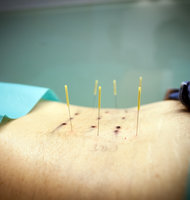








 Augment your stride to prevent exasperation of symptoms.